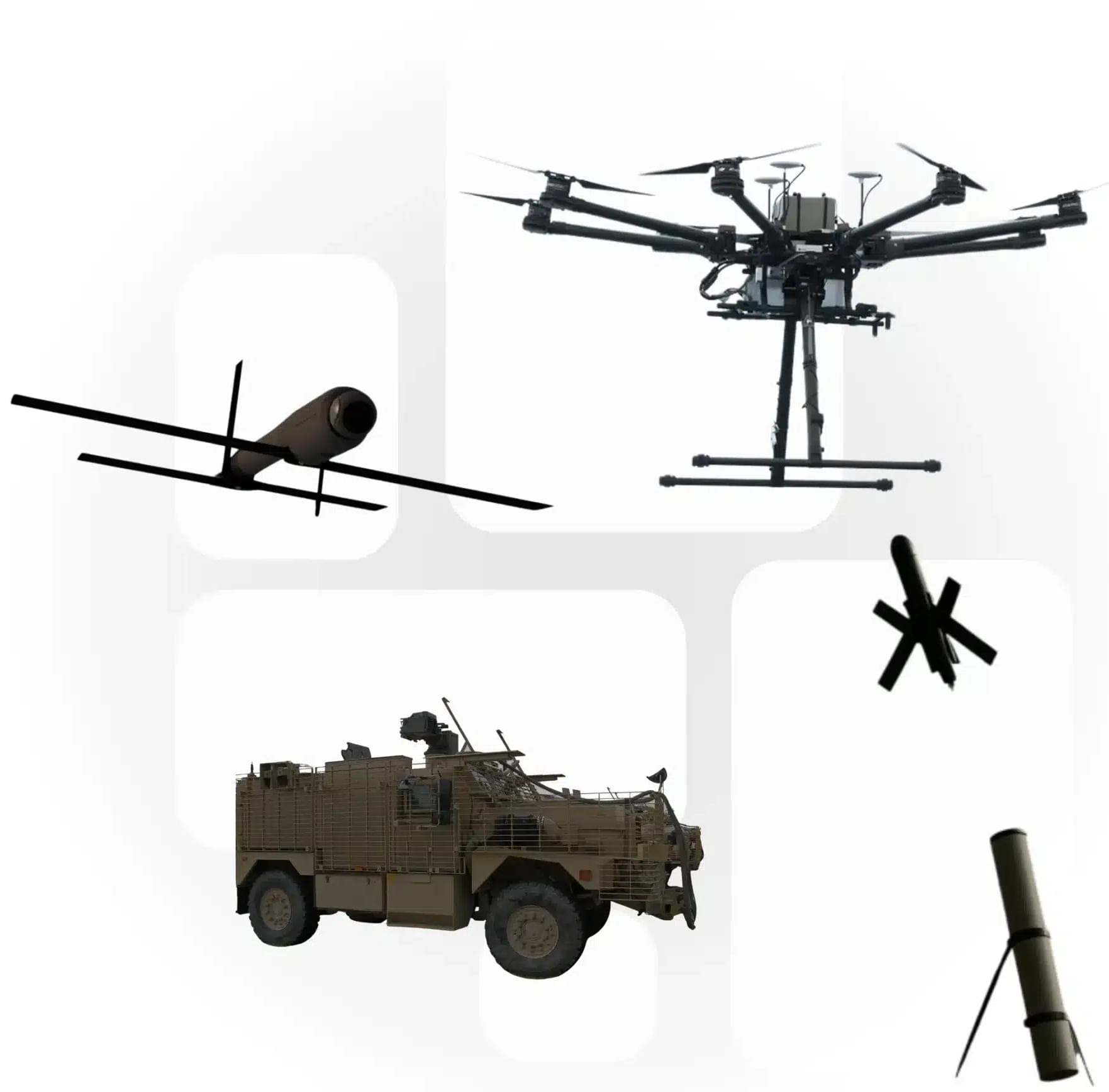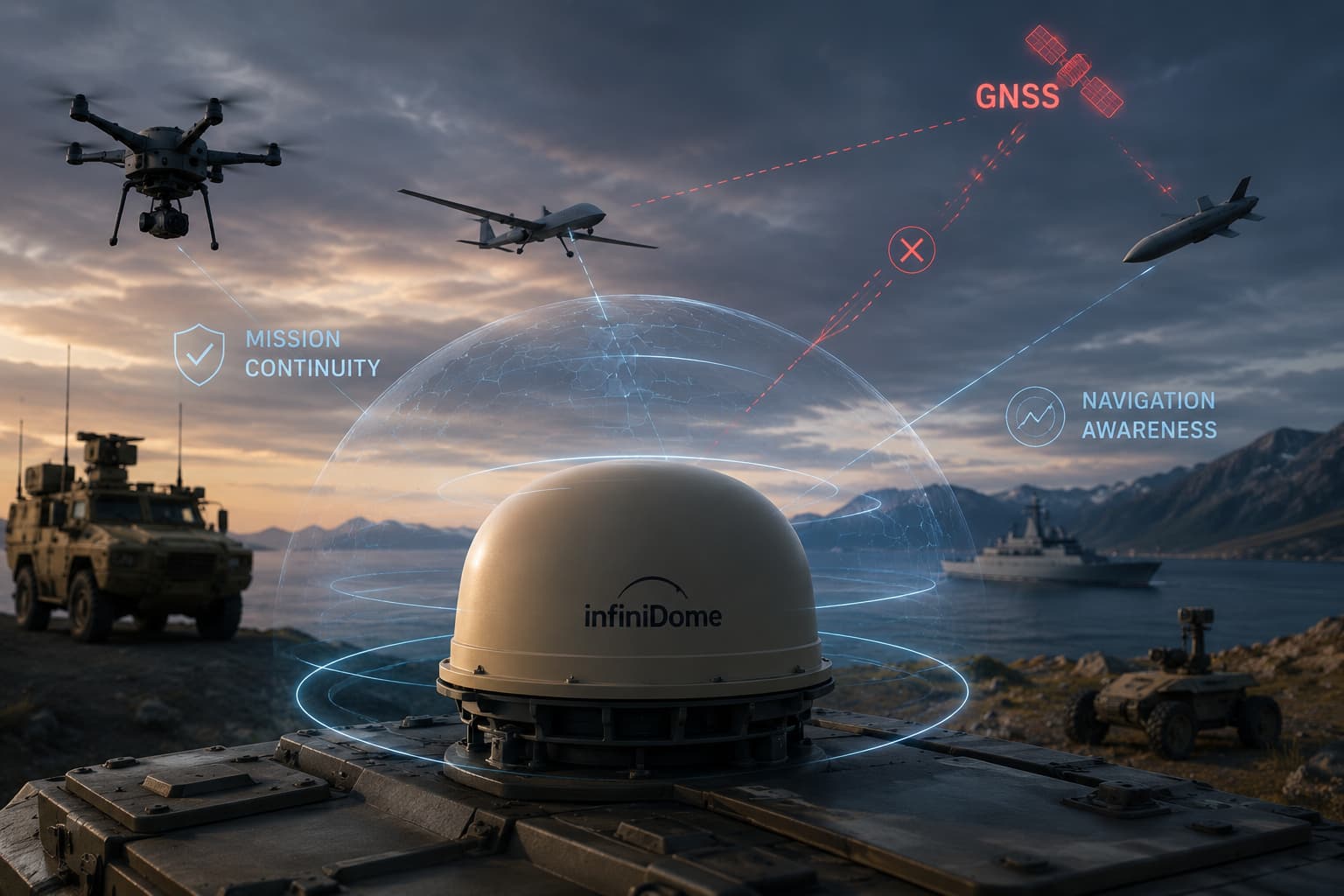

GPS security has become one of the most critical pillars of modern autonomy, defense operations, and command and control infrastructure. As militaries, governments, and commercial industries increase their reliance on Global Navigation Satellite Systems for positioning, navigation, and timing, the number of hostile attempts to disrupt GNSS availability has grown dramatically. In today’s operational reality, GPS security is no longer an optional enhancement but a strategic capability that determines whether autonomous platforms can complete their missions or fail in the field. From fast-moving UAVs to ground vehicles and robotic systems, maintaining continuous access to reliable GNSS signals is essential for mission continuity and safety.
The growing global dependence on GNSS has exposed a fundamental weakness. GNSS signals arriving from satellites are extremely weak by the time they reach the Earth’s surface. This makes them vulnerable to various forms of interference. In modern conflict zones and contested electromagnetic environments, adversaries intentionally disrupt GNSS reception to degrade situational awareness and limit operational effectiveness. As these threats intensify, GPS security has become a core requirement for any autonomous platform expected to operate in dynamic or hostile environments.
GPS security focuses on ensuring that a platform continues to receive usable satellite signals even in the presence of targeted interference. It requires robust RF level protection, field-proven anti-jamming technology, adaptive antenna techniques, and an understanding of operational behavior under degraded navigation conditions. A comprehensive GPS security approach allows aircraft, robots, and vehicles to maintain flight modes, route planning, timing integrity, and mission reliability.
Why GPS Security Has Become a Global Requirement
Over the past decade, the world has seen an exponential rise in GNSS interference events. These events are no longer isolated or accidental. They have become a standard element of modern electronic warfare, border control operations, and area denial strategies. Regions with high military activity frequently experience long-duration disruptions that affect both defense and civilian infrastructure. Commercial aviation, maritime navigation, agricultural automation, and logistics fleets all report frequent loss of GNSS accuracy or total GNSS denial, demonstrating that the threat landscape is rapidly escalating.
This global shift has pushed GPS security into the mainstream as a foundational capability. Defense platforms cannot assume a clean RF environment. UAVs operating beyond visual line of sight must rely on continuous and stable navigation data. Robotic convoys require precise timing and heading information to coordinate movement. Even small tactical drones require protection to maintain basic positioning logic. When GNSS availability collapses, autonomous behavior becomes unpredictable, and mission risk grows exponentially.
Governments and military forces worldwide now consider GPS security a core strategic asset. Investments in anti-jamming systems, hardened antennas, and resilient navigation technologies continue to rise. As operational theaters evolve, so does the technology required to keep GNSS-supported platforms active, stable, and safe.
How GNSS Interference Disrupts Navigation and Mission Continuity
GNSS interference affects far more than simple position accuracy. Once satellite signals degrade beyond a usable threshold, multiple subsystems begin to collapse. Pilots, operators, and onboard autonomy algorithms rely on GNSS inputs not only for location but also for timing, synchronization, and flight mode stability. Even brief interference events can create cascading failures that lead to mission interruption, platform loss, or loss of control.
When GNSS integrity declines, UAVs immediately struggle to maintain stable flight. Functions such as BVLOS navigation, Return to Home, Position Hold and altitude stabilization become unreliable or unavailable. Many autopilot systems are designed around the assumption of continuous GNSS reception. Without reliable timing and position data, they revert to degraded modes or emergency protocols.
Ground vehicles face similar challenges. Robotic platforms lose their ability to follow predefined routes. Timing-dependent systems drift, affecting communication, sensor fusion, and convoy movement. Automated logistics fleets may stop moving entirely or deviate from their assigned corridors. In highly dynamic environments, even one second of lost GNSS signal can create critical errors.
To maintain operational continuity, GPS security must be designed to counter disruption at the RF level before the navigation chain collapses.
Operational Impact of GNSS Loss
Loss of autonomous flight modes that depend on satellite positioning
Immediate drift in UAV trajectory when GNSS inputs fall below required thresholds
Failure of BVLOS mission planning and preprogrammed flight routes
Degraded timing accuracy that affects communication and synchronization
Increase in mission risk due to reduced situational awareness
Higher probability of platform loss in dense or contested RF environments
These failures highlight the operational necessity of robust GPS security integrated directly into the platform architecture.
Why Traditional Solutions Are Not Enough
Many platforms rely on basic GNSS receivers or antenna-level filtering as their primary mitigation strategy. However, these solutions provide minimal protection in real-world interference scenarios. Basic filtering cannot suppress strong jammers. Redundant GNSS receivers do not offer protection when all receivers experience the same RF environment. Adding inertial sensors may offer short-term drift compensation, but it does not replace the need for real satellite signals.
To achieve actionable GPS security, platforms must implement active mitigation systems capable of shaping antenna reception patterns, nulling interference sources, and preserving legitimate satellite signals. Without these measures, modern drones and unmanned ground vehicles remain vulnerable to even low-power interference sources.
Core Principles of Effective GPS Security
Effective GPS security rests on several foundational pillars that together ensure reliable GNSS performance in contested environments:
Protection at the RF front end where GNSS signals are weakest
Adaptive antenna behavior that preserves satellite signals while attenuating interference
Rapid response to dynamic, mobile, or multi-directional jamming sources
Low SWaP design for integration on small UAVs or lightweight platforms
Proven field performance across real operational environments
Full compatibility with existing navigation systems and GNSS receivers
Each of these principles contributes to a robust, resilient architecture for mission-critical autonomy.
The Role of Adaptive Antennas in Achieving GPS Security
Adaptive antennas are one of the most effective tools in the field of GPS security. By dynamically adjusting antenna reception patterns, they can create spatial nulls that attenuate interfering signals while maintaining visibility of legitimate satellite signals. This spatial filtering process significantly improves GNSS resilience in complex environments.
Modern controlled reception pattern antenna (CRPA) systems perform this function with high precision. However, traditional CRPA systems are large, expensive, and require significant power and integration effort. Their size and weight limit their applicability for small UAV platforms, where any added payload reduces operational endurance.
This challenge has led to the development of compact anti-jamming antennas that retain the benefits of spatial filtering while maintaining low SWaP characteristics suitable for small and medium-sized UAVs. Such solutions are essential for maintaining GPS security in platforms with limited payload capacity.
The Need for GPS Security Across UAV Classes
UAVs of all sizes, from nano drones to tactical aircraft, face increasing exposure to GNSS interference. Smaller UAVs, especially Class 1 to Class 3 platforms, are exceptionally vulnerable due to their lightweight design and dependence on a stable GNSS signal for every aspect of flight. Their autopilot systems often rely on GNSS for basic stabilization and cannot compensate effectively during interference events.
Larger UAVs may incorporate more sophisticated sensor fusion systems, but still depend on satellite timing and navigation to maintain mission accuracy. Regardless of platform scale, all UAVs operating in modern theaters require reliable GPS security to ensure safety and mission continuity.
Practical Requirements for Selecting a GPS Security Solution
Choosing the right system depends on operational needs, platform constraints, and mission profiles. Effective GPS security demands a solution that offers real field performance rather than theoretical protection.
Key criteria include:
Demonstrated attenuation of interference in live jamming environments
Full 360-degree coverage for platforms exposed to mobile or multi-directional threats
Minimal added weight to preserve UAV endurance
Low power consumption suitable for battery-powered platforms
Plug-and-play integration with existing avionics and receivers
Operational data and field tests that validate performance
Compatibility with multi-constellation and multi-band GNSS
When assessed together, these criteria determine whether a GPS security product can support missions reliably.
infiniDome’s Contribution to the Future of GPS Security
infiniDome has developed specialized technologies engineered specifically for defending GNSS-dependent platforms from real interference threats. Instead of adapting oversized or heavy CRPA systems, infiniDome focuses on compact, field-proven solutions built for mobility and autonomy.
Solutions like Aura combine advanced spatial filtering, 360-degree anti-jamming protection, and low SWaP characteristics. By suppressing interference at the antenna level, Aura maintains satellite visibility and stabilizes navigation continuity even during high-intensity jamming attempts.
This level of operational resilience transforms how UAVs and autonomous ground platforms can be deployed. Missions that previously required controlled RF environments can now operate confidently in contested regions. Whether securing defense logistics, protecting border operations, or enabling autonomous navigation, infiniDome’s approach strengthens GPS security across a wide range of platforms.
Use Cases Where GPS Security Delivers Operational Advantage
Small UAVs operating beyond line of sight in contested RF regions
Autonomous ground vehicles requiring uninterrupted navigation data
Border surveillance drones exposed to interference from hostile actors
Robotic platforms that must maintain timing synchronization
Tactical missions that rely on accurate GNSS-supported flight profiles
Long-range UAV fleets requiring stable navigation for endurance missions
Across these scenarios, GNSS interference can threaten mission success, and GPS security determines whether systems remain operational.
The Future of GPS Security in a Rapidly Evolving Electromagnetic Landscape
As global electronic warfare capabilities evolve, the role of GPS security will only grow more significant. Defense forces are increasingly integrating navigation resilience as a core component of mission readiness. UAVs and autonomous systems will continue to expand across military, commercial, and government applications, amplifying the strategic importance of resilient GNSS access.
Emerging technologies, new antenna architectures, alternative PNT sources, and AI-enhanced navigation systems will all contribute to the future landscape. Yet even as innovation continues, robust RF level protection will remain the foundation of GPS security. Without it, no advanced algorithm or autonomy stack can perform reliably.
The future belongs to platforms that can maintain navigation integrity regardless of electromagnetic conditions. GPS security is the key enabler of that capability.
Conclusion
In a world defined by contested RF environments, high density electromagnetic activity and rapidly evolving electronic warfare capabilities, GPS security is essential for mission success. It ensures that UAVs, ground vehicles and autonomous systems maintain stable navigation, accurate timing and continuous operational functionality.
Organizations adopting advanced GPS security solutions benefit from increased mission reliability, improved situational awareness and reduced operational risk. As global threats escalate, resilient GNSS protection becomes not only a technological advantage but a strategic necessity.
For platforms that depend on GNSS to move, navigate or operate safely, the question is no longer whether GPS security is needed but how quickly it can be integrated.