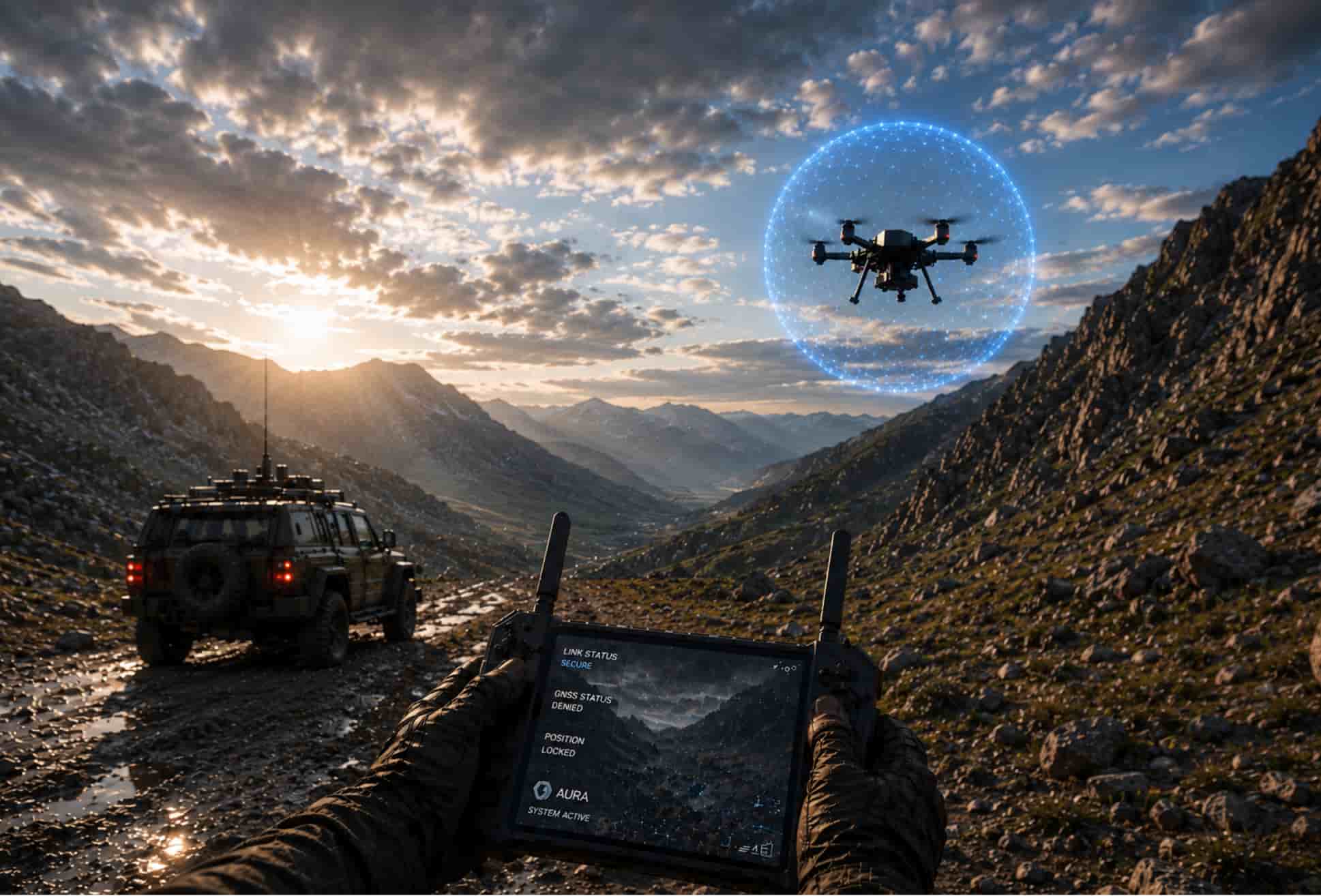
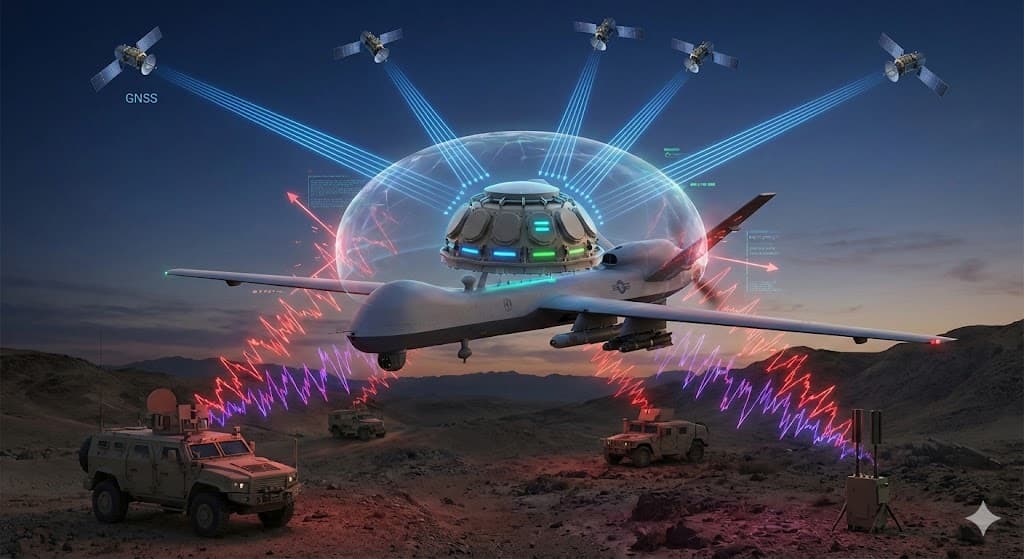
A CRPA anti jamming antenna is a specialized GPS anti jam antenna that protects navigation systems from interference and spoofing by dynamically adjusting its reception pattern. Using advanced signal processing, these antennas block unwanted jamming signals while maintaining access to genuine GNSS satellite signals, ensuring reliable positioning, navigation, and timing.
What is a CRPA Antenna?
A CRPA antenna, short for Controlled Reception Pattern Antenna, is a multi-element GNSS antenna system designed to protect GPS and other satellite-based navigation signals from jamming and spoofing. Unlike a conventional GPS antenna that receives signals equally from all directions, a CRPA antenna can shape and steer its reception pattern to focus on authentic satellite signals while nulling out interference sources.
This makes it one of the most effective forms of an anti jamming antenna, and it is widely used in military, defense, and increasingly in commercial sectors. CRPA antennas are considered the gold standard of protection against intentional jamming and spoofing threats.
How Does a CRPA Anti Jamming Antenna Work?
The CRPA anti jamming antenna operates using an array of multiple antenna elements. These elements are connected to a sophisticated processor that applies beamforming algorithms. By doing so, the system can electronically steer its antenna pattern toward genuine GNSS satellites and away from jammers.
When a jammer attempts to overpower the weak GPS signals, the CRPA antenna introduces a “null” in the direction of the interference. This effectively cancels out the jammer’s signal while still receiving the satellites.
The process includes:
Detection of the direction of incoming interference.
Nulling or steering the antenna array away from the jammer.
Maintaining lock on real GNSS signals without interruption.
This is why CRPA antennas are often referred to as anti-jam GPS antennas, since they actively mitigate the effects of hostile signals.
Benefits and Limitations of CRPA Antennas
The advantages of gps anti jam antennas are significant, especially in high-threat environments. They allow critical systems to maintain operation even when exposed to powerful jamming attempts. However, the technology also comes with certain trade-offs.
Benefits:
Ability to suppress multiple jamming sources simultaneously.
High reliability in contested environments.
Effective protection against both jamming and spoofing.
Suitable for mobile and dynamic platforms such as UAVs, aircraft, and ground vehicles.
Limitations:
Higher cost compared to standard GNSS antennas.
Requires more power and processing capabilities.
Larger form factor, which can be challenging for small drones or handheld devices.
Main Applications and Industries
CRPA antennas are critical for platforms that cannot afford to lose navigation capabilities. They are widely deployed in:
Military aviation – protecting aircraft navigation and targeting systems.
UAVs and drones – ensuring mission continuity against electronic warfare.
Naval vessels – preventing spoofing of shipboard navigation.
Ground vehicles – safeguarding convoys and armored platforms.
Civil aviation and critical infrastructure – airports, power grids, and telecom networks.
As GPS threats spread into civilian spheres, anti jamming antenna solutions are no longer limited to defense. Commercial adoption is steadily growing.
Types of CRPA Antennas
There are different designs of CRPA antennas depending on the mission and platform requirements.
4-element CRPA antenna – commonly used for small platforms and moderate protection.
7-element CRPA antenna – provides stronger suppression of multiple jammers.
9-element and above – designed for high-end defense and large aircraft.
Each configuration offers a trade-off between size, weight, cost, and effectiveness.
Key Performance Factors and Testing
To evaluate a CRPA anti jamming antenna, several performance metrics are considered:
SINR (Signal to Interference and Noise Ratio) – higher is better.
Null depth – the ability to suppress jammer signals in decibels.
Response time – how quickly the antenna adapts to a new jamming source.
Multi-path handling – reducing errors from signal reflections.
Testing is often carried out under MIL-STD conditions to ensure ruggedness and compliance with defense requirements.
Integration with Other Anti-Jamming Technologies
A CRPA anti jamming antenna rarely works alone. It is usually integrated into a broader anti jam system that includes:
GNSS receivers with digital signal processing.
Spoofing detection and spoofing mitigation software.
Inertial navigation systems (INS) for redundancy.
AI-based filtering to distinguish authentic signals.
This layered approach ensures resilience for Positioning, Navigation, and Timing (PNT) in the most demanding scenarios.
Leading Manufacturers and Market Trends
Several global players develop gps anti jam antennas, including defense giants and specialized navigation companies. Among them are NovAtel, Raytheon, Honeywell, and innovators like Infinidome, which focus on scalable CRPA solutions for UAVs and commercial platforms.
The future trend is toward miniaturization, reducing costs, and enabling mass adoption for commercial drones and autonomous vehicles.
FAQ on CRPA Anti Jamming Antennas
What is a CRPA antenna?
A CRPA antenna is a Controlled Reception Pattern Antenna that protects GNSS signals by electronically steering its reception pattern to block jammers.
How does a CRPA anti jamming antenna stop GPS jamming?
It creates nulls in the direction of interference while keeping lock on real satellite signals.
Where are CRPA antennas used?
They are used in military aircraft, drones, ships, ground vehicles, and critical civilian infrastructure.
Are CRPA antennas expensive?
Yes, they cost more than standard GPS antennas due to their advanced technology and processing requirements.
What is the difference between a CRPA antenna and a normal GPS antenna?
A normal antenna receives all signals equally, while a CRPA antenna can filter out interference and focus only on genuine GNSS signals.
Conclusion
The CRPA anti jamming antenna is one of the most advanced and effective defenses against GNSS jamming and spoofing. By dynamically adjusting its reception pattern, it ensures that critical systems continue to operate even in hostile environments. As threats expand beyond the battlefield into civilian life, the importance of anti jamming antennas will only grow. Companies like Infinidome are at the forefront of bringing this technology to both defense and commercial markets, ensuring resilient and secure GPS navigation for the future.