
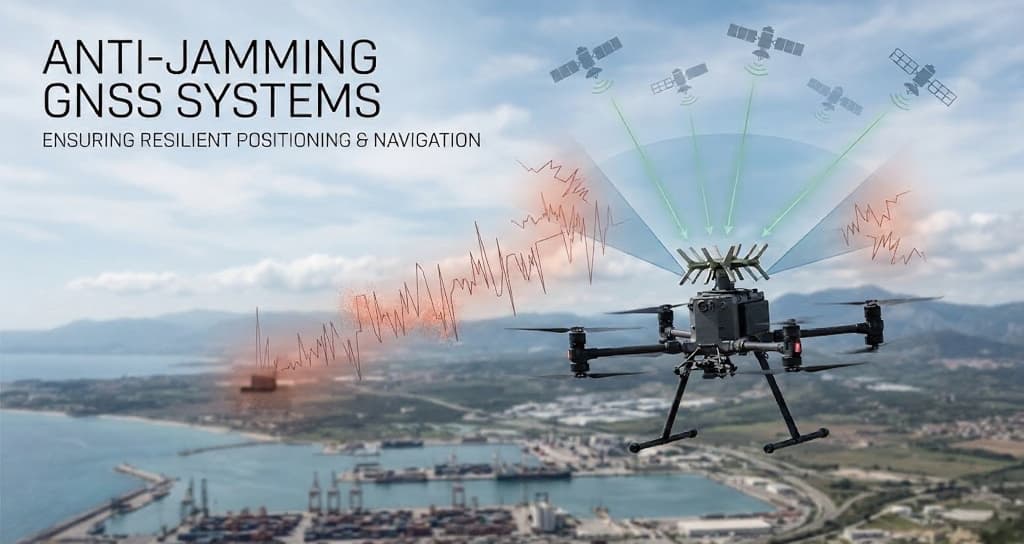
Anti Jamming GNSS Systems
Anti jamming GNSS systems are advanced solutions designed to detect, suppress, and mitigate intentional or unintentional interference, ensuring reliable positioning, navigation, and timing even in highly contested environments. As GNSS disruptions become more frequent worldwide, these technologies have shifted from a niche military capability to a critical component across defense, aviation, maritime, and autonomous systems.
GNSS (Global Navigation Satellite Systems) refers to the global family of satellite navigation systems including GPS (United States), Galileo (Europe), GLONASS (Russia), and BeiDou (China). While GPS is the most widely known and commonly used constellation, modern navigation receivers often rely on signals from multiple GNSS systems simultaneously.
Anti jamming GNSS technologies protect satellite navigation signals by identifying interference sources in real time and actively suppressing them using advanced RF filtering, antenna techniques, digital signal processing, and adaptive mitigation methods. This allows continuous and accurate positioning even when strong jammers are present.
Why GNSS Signals Are Vulnerable to Jamming
GNSS systems such as GPS rely on signals transmitted from satellites orbiting approximately 20,000 kilometers above Earth. By the time these signals reach a receiver, they are extremely weak. This physical reality makes GNSS inherently susceptible to interference. Even low power transmitters can overwhelm the signal, intentionally or unintentionally.
In recent years, jamming has become more accessible. Commercially available jammers, experimental transmitters, and even malfunctioning equipment can disrupt GNSS reception over wide areas. The impact is not theoretical. Real world incidents have caused flight delays, maritime navigation errors, drone crashes, and disruptions to critical infrastructure.
As reliance on satellite navigation continues to grow, the consequences of GNSS denial are no longer limited to military theaters. Civil aviation, ports, telecom networks, and autonomous vehicles now face similar risks, making anti jamming GNSS technologies a foundational capability rather than an optional enhancement.
How GNSS Jamming Works in Practice
GNSS jamming operates by transmitting noise or interference on the same frequency bands used by GNSS satellites. When the jammer’s signal reaches the receiver with greater power than the satellite signal, the receiver loses the ability to lock onto valid navigation data.
There are several common jamming methods:
Wideband noise jamming that floods the entire GNSS spectrum
Narrowband jamming that targets specific frequencies such as L1 or L2
Sweep jamming that rapidly shifts frequencies to evade simple filters
Proximity jamming where the jammer is physically close to the receiver
These techniques can affect anything from handheld devices to complex navigation systems. Anti jamming technologies are designed specifically to counter these tactics at the physical signal level.
How Anti Jamming GNSS Protection Works
Anti jamming GNSS protection systems combine specialized RF hardware and advanced signal processing to protect GNSS reception. Unlike standard receivers that passively accept signals, these systems actively analyze the radio frequency environment and respond dynamically to interference.
At the core of the system is the ability to differentiate between authentic satellite signals and interference. This is achieved through spatial processing, time domain analysis, and frequency domain filtering. When interference is detected, the system suppresses or filters the unwanted signal before it disrupts the navigation receiver.
Key functional stages include:
Continuous monitoring of signal quality and noise levels
Detection of anomalous power spikes or spectral patterns
Identification of interference characteristics
Adaptive suppression or filtering of the jammer signal
Preservation of authentic GNSS signal tracking
This real time adaptability is what separates advanced anti jamming protection systems from traditional GNSS hardware.
Core Technologies Behind Anti Jamming GNSS Protection
CRPA Antennas and Spatial Filtering
Controlled Reception Pattern Antennas, commonly known as CRPA, are one of the most effective tools against jamming. Instead of using a single antenna element, CRPA systems use multiple elements arranged in a precise geometry.
By comparing the phase and amplitude of incoming signals across these elements, the system can determine the direction of arrival. This enables the formation of spatial nulls that suppress signals coming from the jammer while maintaining sensitivity toward satellites.
Key benefits include:
Simultaneous suppression of multiple jammers
Minimal impact on legitimate satellite signals
High effectiveness against high power interference
Digital Beamforming and Adaptive Nulling
Digital beamforming allows the antenna system to shape its reception pattern electronically rather than mechanically. This is crucial in dynamic environments where jammers may move or change behavior.
Adaptive nulling continuously recalculates where interference is coming from and places deep nulls in those directions. The process happens in milliseconds, allowing uninterrupted navigation even in rapidly changing RF conditions.
This technology is especially valuable for platforms such as UAVs and mobile military systems that cannot rely on static interference models.
Advanced Signal Processing and Filtering
Beyond antenna level mitigation, anti jamming protection relies heavily on digital signal processing. Sophisticated algorithms analyze signal characteristics to isolate authentic GNSS signals buried within noise.
Techniques include:
Narrowband and adaptive filtering
Time frequency analysis
Signal integrity monitoring
Dynamic thresholding
These layers work together to ensure resilience even when interference conditions fluctuate rapidly.
Anti Jamming vs Anti Spoofing
A common point of confusion is the distinction between jamming and spoofing. While both target GNSS systems, they represent different threats.
Jamming focuses on denial of service by overpowering the signal. Spoofing aims to deceive the receiver by transmitting counterfeit GNSS signals that appear legitimate but contain false navigation data.
Anti jamming technologies primarily protect against signal denial. While some advanced systems integrate anti spoofing features, the two are not interchangeable. In high risk environments, a combined approach is often required.
Understanding this distinction is essential when evaluating GNSS protection solutions and aligning them with operational requirements.
Applications of Anti Jamming GNSS Protection
Anti jamming technologies are now deployed across a wide range of sectors. Each use case has unique operational demands, but all share the need for continuous and reliable positioning.
Key application areas include:
Defense platforms such as vehicles, missiles, and soldier systems
UAVs and unmanned aerial systems operating in contested airspace
Maritime navigation in congested or sensitive regions
Aviation systems supporting approach, landing, and timing
Critical infrastructure relying on precise timing and synchronization
Autonomous vehicles and robotics requiring uninterrupted navigation
As GNSS reliance expands, so does the scope of anti jamming adoption.
Why UAVs Are Especially Vulnerable to GNSS Disruptions
Unmanned aerial vehicles are among the most vulnerable platforms when GNSS is disrupted. Many UAVs rely on GNSS signals for stabilization, waypoint navigation, geofencing, and return-to-home functionality.
Unlike ground vehicles, UAVs are not physically anchored to the ground. When GNSS positioning is lost or degraded, the aircraft can quickly drift due to wind, inertia, or control instability.
When jamming occurs, the consequences can be immediate:
Loss of navigation accuracy
Unexpected flight behavior
Significant drift from the intended flight path
Mission aborts or crashes
Loss of asset control
For UAVs, GNSS protection is therefore not only a performance improvement but often a critical safety requirement that enables reliable operation in contested RF environments.
Performance Metrics That Matter
Evaluating anti jamming GNSS solutions requires more than marketing claims. Several measurable parameters determine real world effectiveness.
Important performance metrics include:
Jammer to signal ratio tolerance
Number of simultaneous jammers supported
Reaction time to new interference
Residual position error under jamming
Size, weight, and power consumption
Integration compatibility with existing GNSS systems
These metrics help decision makers compare solutions objectively and match them to platform constraints.
Regulatory and Compliance Considerations
The deployment of anti jamming GNSS protection must align with regulatory frameworks that vary by region and application. Military systems often operate under different rules than civil aviation or maritime platforms.
Key considerations include:
Export control regulations
Frequency usage compliance
Certification for aviation or maritime use
Interoperability with existing navigation standards
Addressing these factors early in system design helps avoid delays and ensures operational readiness.
The infiniDome Approach to GNSS Anti Jamming
infiniDome focuses on practical and scalable GNSS protection designed for easy integration with existing navigation systems.
Unlike solutions that require replacing the GNSS receiver or using complex antenna arrays, infiniDome provides a dedicated anti-jamming module that operates between the GNSS antenna and the navigation receiver.
The system receives the RF signal from a standard GNSS antenna, actively filters and mitigates interference, and then forwards a cleaner and more resilient signal to the existing GNSS receiver.
This architecture offers several important advantages:
Compatibility with existing GNSS receivers
Minimal integration complexity
No need to redesign the navigation stack
Improved resilience against RF interference
Scalable protection across multiple platforms
By focusing on inline RF protection rather than receiver replacement, infiniDome enables platforms to upgrade their GNSS resilience quickly and cost-effectively.
These solutions are widely used across applications such as UAVs, defense systems, maritime platforms, and autonomous technologies operating in challenging RF environments.
Frequently Asked Questions About GNSS Anti Jamming
What are anti jamming GNSS systems?
They are technologies designed to detect and suppress interference, maintaining accurate positioning even in the presence of jamming.
How effective are anti jamming systems against strong jammers?
Effectiveness depends on RF design, signal processing, and system architecture. Advanced systems can mitigate multiple high power interference sources simultaneously.
Do anti jamming systems also prevent spoofing?
Not necessarily. Anti jamming focuses on interference suppression. Some systems integrate additional anti spoofing capabilities.
Are anti jamming technologies legal for civilian use?
Yes, in many applications, but usage must comply with local regulations and certification requirements.
Which platforms benefit most from GNSS protection?
UAVs, military vehicles, maritime systems, aviation platforms, and critical infrastructure all benefit significantly.
Summary and Next Steps
GNSS interference is no longer a rare or isolated phenomenon. As dependence on satellite navigation continues to grow, so does the risk posed by jamming. Anti jamming technologies provide a proven and essential layer of protection, enabling reliable navigation and timing even in the most challenging RF environments.
For organizations operating in defense, aerospace, maritime, or autonomous systems, investing in robust GNSS protection is becoming a strategic necessity.
Solutions such as those developed by infiniDome enable rapid integration of anti-jamming protection into existing platforms by protecting the GNSS signal path between the antenna and receiver, allowing systems to maintain reliable positioning even in contested RF conditions.